
-
-
-
-
-
-
-
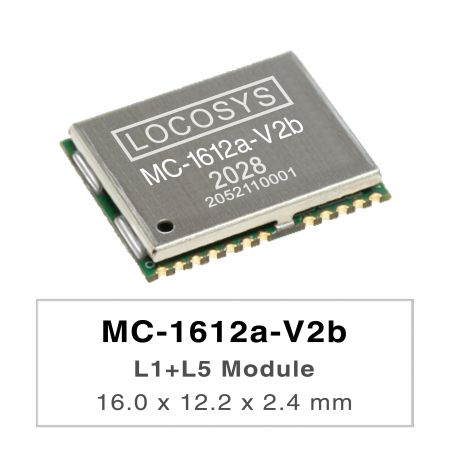
MC-1612a-V2b
MC-1612a-V2b
LOCOSYS MC-1612a-Vxx is a high-performance dual-band GNSS positioning module that is capable of tracking all global civil navigation systems. It adopts 12 nm process and integrates efficient power management architecture to perform low power and high sensitivity. Besides, concurrent reception of L1 and L5 band signals mitigates the multipath delay and achieves more accurate position. The module supports hybrid ephemeris prediction to achieve faster cold start. One is self-generated ephemeris prediction (called EPOC) that is no need of both network assistance and host CPU’s intervention. This is valid for up to 3 days and updates automatically from time to time when GNSS module is powered on and satellites are available. The other is server-generated ephemeris prediction (called EPO) that gets from an internet server. This is valid for up to 14 days. Both ephemeris predictions are stored in the on-board flash memory and perform a faster cold start. The RF front end of MC-161a-V3b the module is specifically designed to comply with sensitivity specification contained in AIS 140 standard. It is the best solution to those customers that design tracking applications in compliance with AIS 140.
-
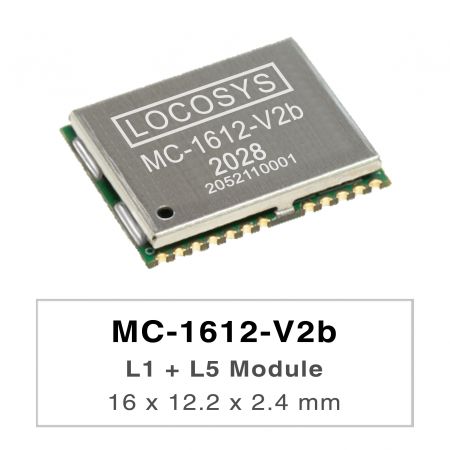
MC-1612-V2b
MC-1612-V2b
LOCOSYS MC-1612-Vxx series are high-performance dual-band GNSS positioning modules that are capable of tracking all global civil navigation systems. They adopt 12 nm process and integrate efficient power management architecture to perform low power and high sensitivity. Besides, concurrent reception of L1 and L5 band signals mitigates the multipath delay and achieves sub-meter position accuracy. The modules support hybrid ephemeris prediction to achieve faster cold start. One is self-generated ephemeris prediction (called EPOC) that is no need of both network assistance and host CPU’s intervention. This is valid for up to 3 days and updates automatically from time to time when GNSS module is powered on and satellites are available. The other is server-generated ephemeris prediction (called EPO) that gets from an internet server. This is valid for up to 14 days. Both ephemeris predictions are stored in the on-board flash memory and perform a cold start time less than 15 seconds The RF front end of MC-1612-V3b the module is specifically designed to comply with sensitivity specification contained in AIS 140 standard. It is the best solution to those customers that design tracking applications in compliance with AIS 140.
-
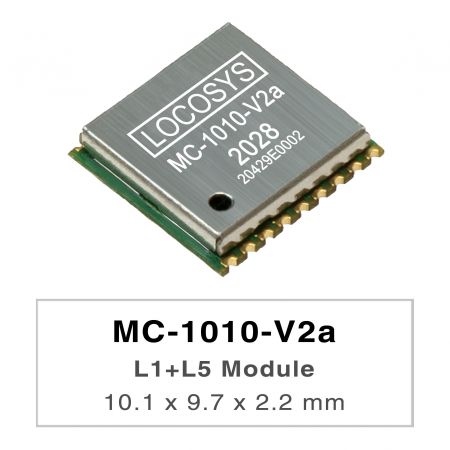
MC-1010-V2a
MC-1010-V2a
LOCOSYS MC-1010-Vxx series are high-performance dual-band GNSS positioning modules that are capable of tracking all global civil navigation systems. They adopt 12 nm process and integrate efficient power management architecture to perform low power and high sensitivity. Besides, concurrent reception of L1 and L5 band signals mitigates the multipath delay and achieves sub-meter position accuracy. The modules support hybrid ephemeris prediction to achieve faster cold start. One is self-generated ephemeris prediction (called EPOC) that is no need of both network assistance and host CPU’s intervention. This is valid for up to 3 days and updates automatically from time to time when GNSS module is powered on and satellites are available. The other is server-generated ephemeris prediction (called EPO) that gets from an internet server. This is valid for up to 14 days. Both ephemeris predictions are stored in the on-board flash memory and perform a cold start time less than 15 seconds. MC-1010-V3x with the active antenna can comply with the sensitivity specification contained in AIS 140 standard. It is the best solution to those customers that design tracking applications in compliance with AIS 140.
-
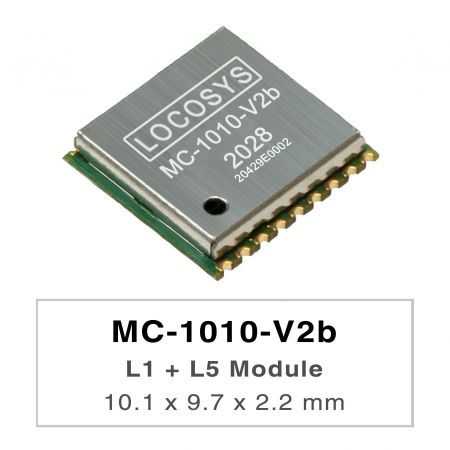
MC-1010-V2b
MC-1010-V2b
LOCOSYS MC-1010-Vxx series are high-performance dual-band GNSS positioning modules that are capable of tracking all global civil navigation systems. They adopt 12 nm process and integrate efficient power management architecture to perform low power and high sensitivity. Besides, concurrent reception of L1 and L5 band signals mitigates the multipath delay and achieves sub-meter position accuracy. The modules support hybrid ephemeris prediction to achieve faster cold start. One is self-generated ephemeris prediction (called EPOC) that is no need of both network assistance and host CPU’s intervention. This is valid for up to 3 days and updates automatically from time to time when GNSS module is powered on and satellites are available. The other is server-generated ephemeris prediction (called EPO) that gets from an internet server. This is valid for up to 14 days. Both ephemeris predictions are stored in the on-board flash memory and perform a cold start time less than 15 seconds. MC-1010-V3x with the active antenna can comply with the sensitivity specification contained in AIS 140 standard. It is the best solution to those customers that design tracking applications in compliance with AIS 140.
-
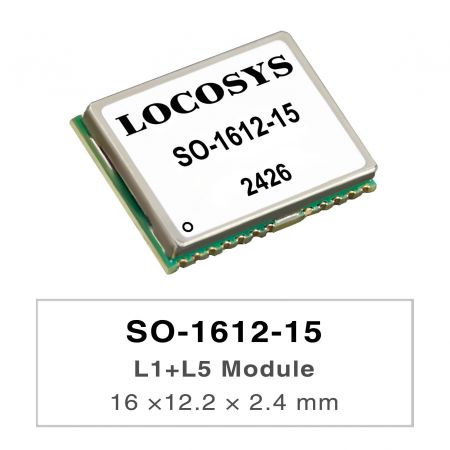
SO-1612-15
SO-1612-15
SO-1612-15 is a dual-band GNSS positioning receiving modules that a capable of tracking all global civil navigation systems (BDS, GPS, GLONASS, Galileo, QZSS, IRNSS and SBAS) in all band bands. Built-in highly integrated GNSS receiving chip supports the third generation Beidou Satellite Navigation System (BDS-3). SO-1612-15 module is based on the state of art BDS-3 architecture, integrating multi-band and multi-system GNSS RF and baseband. This newly designed architecture makes this single chip achieve sub-meter level position accuracy without correction data from ground-based augmentation station and higher sensitivity, greater for improved jam resistance and multipath, provide a highly robust service in complicated environment. SO-1612-15 module contains CXD5610GF positioning engine inside, featuring high sensitivity, low power consumption, and fast TTFF. The superior cold start sensitivity allows it to acquire, track, and get position fix autonomously in difficult weak signal environment. The receiver’s superior tracking sensitivity allows continuous position coverage in nearly all outdoor application environments.
-
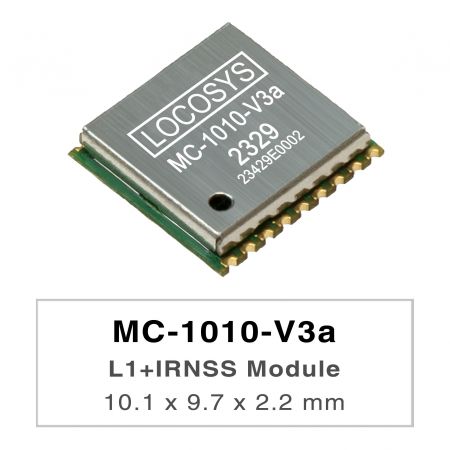
MC-1010-V3a
MC-1010-V3a
LOCOSYS MC-1010-Vxx series are high-performance dual-band GNSS positioning modules that are capable of tracking all global civil navigation systems. They adopt 12 nm process and integrate efficient power management architecture to perform low power and high sensitivity. Besides, concurrent reception of L1 and L5 band signals mitigates the multipath delay and achieves sub-meter position accuracy. The modules support hybrid ephemeris prediction to achieve faster cold start. One is self-generated ephemeris prediction (called EPOC) that is no need of both network assistance and host CPU’s intervention. This is valid for up to 3 days and updates automatically from time to time when GNSS module is powered on and satellites are available. The other is server-generated ephemeris prediction (called EPO) that gets from an internet server. This is valid for up to 14 days. Both ephemeris predictions are stored in the on-board flash memory and perform a cold start time less than 15 seconds. MC-1010-V3x with the active antenna can comply with the sensitivity specification contained in AIS 140 standard. It is the best solution to those customers that design tracking applications in compliance with AIS 140.
-
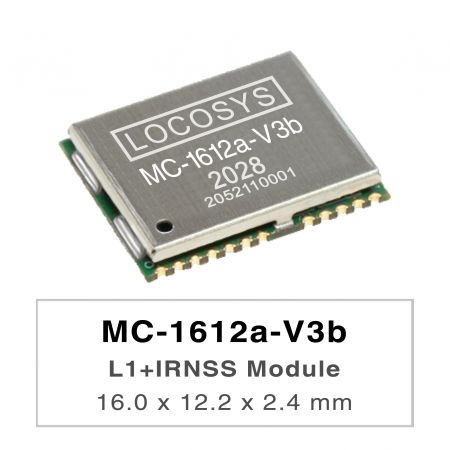
MC-1612a-V3b
MC-1612a-V3b
LOCOSYS MC-1612a-Vxx is a high-performance dual-band GNSS positioning module that is capable of tracking all global civil navigation systems. It adopts 12 nm process and integrates efficient power management architecture to perform low power and high sensitivity. Besides, concurrent reception of L1 and L5 band signals mitigates the multipath delay and achieves more accurate position. The module supports hybrid ephemeris prediction to achieve faster cold start. One is self-generated ephemeris prediction (called EPOC) that is no need of both network assistance and host CPU’s intervention. This is valid for up to 3 days and updates automatically from time to time when GNSS module is powered on and satellites are available. The other is server-generated ephemeris prediction (called EPO) that gets from an internet server. This is valid for up to 14 days. Both ephemeris predictions are stored in the on-board flash memory and perform a faster cold start. The RF front end of MC-161a-V3b the module is specifically designed to comply with sensitivity specification contained in AIS 140 standard. It is the best solution to those customers that design tracking applications in compliance with AIS 140.
-
-
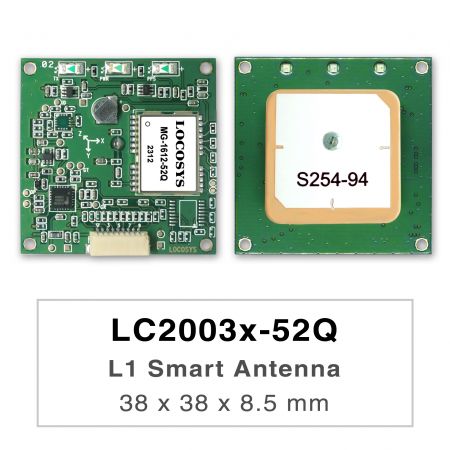
LC2003x-52Q
LC2003x-52Q
LC2003x-52Q Series is a high-performance L1-band GNSS smart antenna module that integrates a powerful GNSS receiver with a compact embedded patch antenna. Designed for a wide range of OEM system applications, this module offers fast time-to-first-fix (TTFF), superior sensitivity, and low power consumption, delivering reliable positioning even in challenging urban or obstructed environments. It is an ideal solution for automotive navigation, asset tracking, and various location-based services (LBS) where accuracy and responsiveness are critical. LC20031-52Qe model is equipped with a built-in e-compass. It supports a default 5Hz high update rate in UBX protocol format, delivering low- latency output and smooth real-time performance making it particularly well-suited for drone navigation, autonomous systems, and other dynamic applications that demand stable and high- frequency position updates.
-
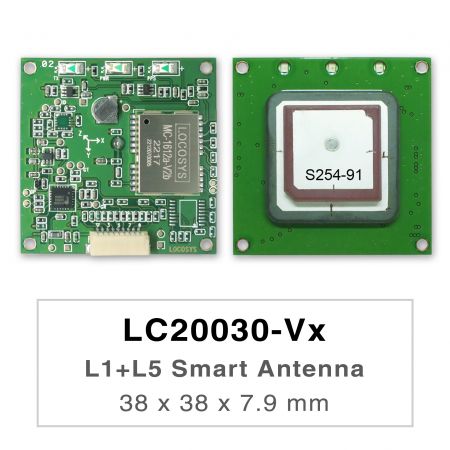
LC2003x-Vx
LC2003x-Vx
LC2003x-Vx series products are high-performance dual-band GNSS smart antenna modules, including an embedded antenna and GNSS receiver circuits, designed for a wide rage of OEM system applications. The GNSS smart antenna can support L1 only signals, or support both L1 and L5 signals, while providing better standalone position accuracy. It can provide fast Time-To-First-Fix, superior sensitivity and low power consumption, delivering reliable positioning even in challenging urban or obstructed environments. It is an ideal solution for automotive navigation, asset tracking, and various location-based services (LBS) where accuracy and responsiveness are critical. LC20031-V2e model is equipped with a built-in e-compass. It supports a default 5Hz high update rate in UBX protocol format, delivering low- latency output and smooth real-time performance making it particularly well-suited for drone navigation, autonomous systems, and other dynamic applications that demand stable and high- frequency position updates.
-
-
-
-
-
-
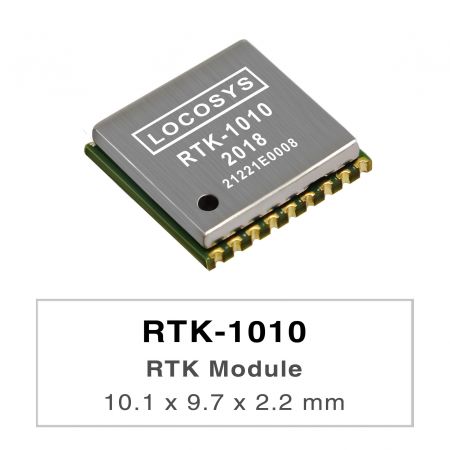
RTK-1010
RTK-1010
The RTK-1010 is a high-performance dual-band GNSS RTK module that designed for applications requiring centimeter level positioning accuracy. It adopts 12 nm process and integrate efficient power management architecture to perform low power and high sensitivity. The module supports concurrent reception of GPS, GLONASS, BeiDou, GALILEO, and QZSS to improve the availability and reliability of RTK solution even in the harsh environment.
-
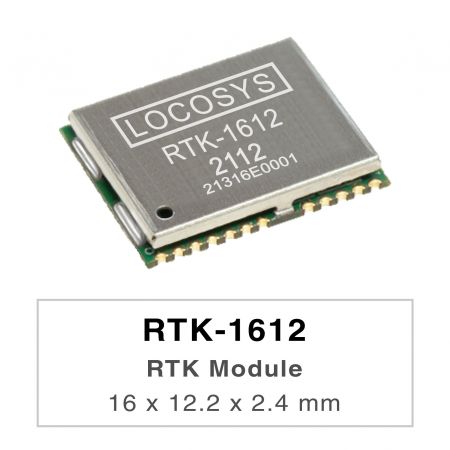
RTK-1612
RTK-1612
The RTK-1612 is a high-performance dual-band GNSS RTK module that designed for applications requiring centimeter level positioning accuracy. It adopts 12 nm process and integrate efficient power management architecture to perform low power and high sensitivity. The module supports concurrent reception of GPS, GLONASS, BeiDou, GALILEO, and QZSS to improve the availability and reliability of RTK solution even in the harsh environment.
-
Press Release
-
 LOCOSYS Targets High-Precision Positioning Market
As global demand for autonomous mobile platforms and intelligent navigation continues to surge, LOCOSYS Technology has officially launched its new-generation dual-frequency GNSS module,...
Read More -
 Taiwan Excellence Drone Alliance Visits LOCOSYS Technology, Focusing On Global Positioning Technology And Drone Applications
The Taiwan Excellence Drone Overseas Business Alliance, led by Yen Tung-Piao,visited a leading smart manufacturing enterprise with a delegation includingrepresentatives from AIDC, the Industrial...
Read More -
 LOCOSYS Showcases Advanced Smart Positioning Technology At New Taipei Electric Vehicle Supply Chain Expo
To promote the development of Taiwan's electric vehicle (EV) industry and enhance international collaboration, the New Taipei City Government hosted the Electric Vehicle Supply Chain Expo...
Read More