
Antenna
LOCOSYS GNSS/RTK Helical Antennas: L1+L5 Dual-Band vs. L1+L2+L5+L6 / L-Band Full-Band
1. Product Positioning Overview
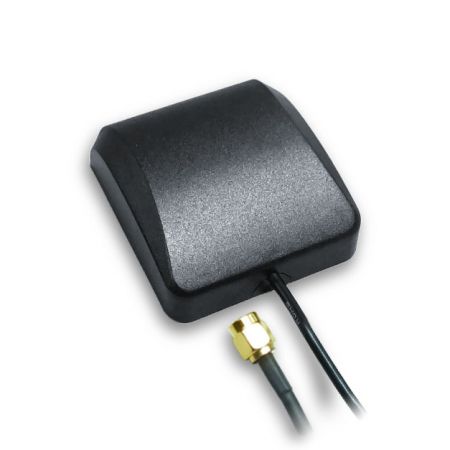
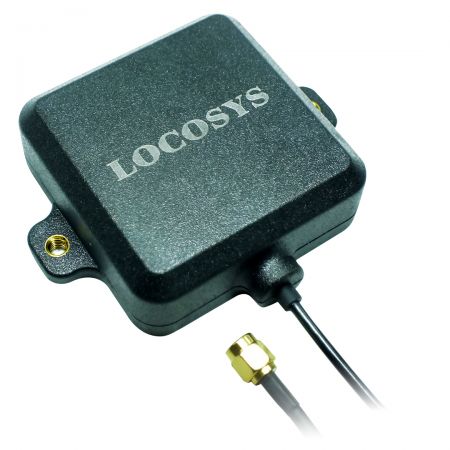
The LOCOSYS GNSS/RTK helical antenna series features a compact, lightweight design, wide beamwidth, and Right-Hand Circular Polarization (RHCP) to provide reliable satellite signal reception for UAVs during banking, turning, climbing, and high-speed flight.
- L1+L5 Dual-Band Series: Optimized for lightweight design, low power consumption, and ease of integration. Ideal for standard RTK UAVs, aerial photography, infrastructure inspection, logistics, and small- to medium-sized UAV platforms.
- L1+L2+L5+L6 / L-Band Full-Band Series: Supports a broader range of GNSS frequency bands and correction service compatibility, making it ideal for surveying and mapping, long-range operations, high-value missions, and challenging signal environments.
Selection Consideration: The antenna must be matched to the frequency bands supported by the GNSS/RTK receiver. If the receiver supports only L1+L5, replacing the antenna with a full-band model alone will not enable L2, L6, or L-Band functionality. Full-band capability can only be achieved when both the antenna and the receiver support the corresponding frequency bands.
2. Multi-System and Multi-Band Support
LOCOSYS antennas support multiple satellite systems, including GPS, GLONASS, BeiDou, Galileo, and QZSS. They also provide multi-band compatibility, including:
- L1 Band (1575.42 MHz): The primary frequency for most global navigation systems.
- L2 Band (1227.60 MHz): Enhances positioning accuracy, commonly used in high-precision RTK applications.
- L5 Band (1176.45 MHz): A high-frequency band offering superior anti-interference capabilities, ideal for demanding applications.
- L6 Band (1278.75 MHz): A unique frequency for certain GNSS systems, such as QZSS, enabling high-precision signal transmission.
- L-Band (approximately 1.2 GHz to 1.6 GHz): Provides extensive high-accuracy differential correction signals, such as for PPP applications.
3. Core Specifications Comparison
| Comparison Item | L1+L5 Dual-Band Helical Antenna | L1+L2+L5+L6 / L-Band Full-Band Helical Antenna |
| Representative Models |
|
LH-1256AR-D、LH-1256AR-E |
| Antenna Type |
|
Active Multi-Constellation, Multi-Band GNSS Helical Antenna |
| GPS |
|
L1、L2、L5 |
| QZSS |
|
L1、L2、L5、L6 |
| GLONASS |
|
L1、L2、L3 |
| Galileo |
|
E1、E5a、E5b、E6 |
| BeiDou |
|
B1I、B1C、B2a、B2b、B3I |
| NavIC / IRNSS |
|
L5 |
| L-Band |
|
Supported D: 1542 ± 17 MHz E: 1525–1559 MHz |
| LNA Gain |
|
30 ± 3 dB (D); 39 ± 3 dB (E) |
| Operating Voltage |
|
3–12 |
| Operating Temperature |
|
−40°C to +85°C |
| Dimensions |
|
Ø43.5 × 40.8 mm |
| Published Weight |
|
LH-1256AR-D: ≤32 g |
| RTK Compatibility |
|
Suitable for Dual-, Triple-, and Multi-Band RTK systems; compatible with receivers and correction services supporting L6 / L-Band. |
| Integration Complexity |
|
Higher; receiver frequency support, power supply, RF cable, filtering, and correction service compatibility should be verified. |
| System Positioning |
|
High Performance; Designed for Mission-Critical Applications |
Note: Connector type, cable length, mounting base, and environmental sealing vary by model. Please refer to the official specifications and project-specific configuration for details.
4. Advantages of L1+L5 Dual-Band Antennas
- Balanced Performance and Payload: With a weight of no more than 17 g, the LH-105A2-B is ideal for small- and medium-sized UAVs where payload capacity, flight endurance, and center-of-gravity management are critical.
- Reduced Ionospheric Error: By utilizing both the L1 and L5 frequencies, compatible GNSS receivers can estimate and mitigate ionospheric delay more effectively than single-frequency systems, enabling higher positioning accuracy.
- High-Quality L5 Signal Reception: When paired with an L5-capable receiver, the antenna helps improve positioning stability and measurement quality, particularly in multipath-prone environments.
- Lower Integration Complexity: RF architecture, supported frequency bands, and overall system cost are easier to manage, making it an ideal upgrade for existing L1+L5 GNSS/RTK platforms.
- Well Suited for High-Volume Commercial Applications: Widely applicable to aerial photography, infrastructure inspection, precision agriculture, logistics, FPV and small UAVs, as well as general autonomous aerial platforms.
5. Advantages of L1+L2+L5+L6 / L-Band Full-Band Antennas
- More Multi-Frequency Observations: Simultaneous reception of L1, L2, L5, and other GNSS signals provides greater observation redundancy for RTK processing, helping reduce time-to-fix and improve recovery after signal interruption. Actual performance depends on the receiver, satellite visibility, baseline distance, and positioning algorithms.
- Broader Multi-Constellation Coverage: Supports multiple frequency bands across GPS, GLONASS, Galileo, BeiDou, QZSS, and NavIC, providing greater flexibility in available satellites and signal combinations.
- Support for L6/E6 and L-Band Correction Services: Compatible with receivers supporting QZSS L6, Galileo E6, or satellite-delivered L-Band PPP/SSR correction services, reducing dependence on terrestrial communication links. Service availability varies by region, subscription plan, and receiver capability.
- Designed for Challenging Environments and Mission-Critical Applications: Multi-frequency redundancy improves RTK solution availability in environments such as urban fringes, valleys, forests, or partially obstructed areas. However, the antenna itself cannot eliminate signal blockage or RF interference.
- Future-Proof Platform Upgrade Path: A single antenna platform can support current dual-band, triple-band, and future multi-band GNSS/RTK receivers, helping reduce hardware redesign risks for high-end UAV platforms.
6. Comparison of UAV Application Characteristics
| UAV Application / Requirement | Recommended Series | Reason for Recommendation |
| Small UAVs, FPV, Lightweight Inspection |
L1+L5 Dual-Band |
Lightweight, easy to integrate, while maintaining long flight endurance and reliable dual-band positioning performance. |
| Aerial Photography, Precision Agriculture, Logistics & Delivery |
L1+L5 Dual-Band |
Offers an excellent balance of cost and performance, meeting the positioning and navigation requirements of most dual-band RTK applications. |
| Surveying & Mapping, Orthophoto Imaging, 3D Modeling |
Full-Band |
Multi-frequency observations help achieve faster and more reliable RTK fixed solutions while reducing operational risks during field surveys. |
| Long-Range VTOL and BVLOS Missions |
Full-Band |
Supports multi-frequency redundancy and L6/L-Band compatibility, making it well suited for high-reliability navigation systems. |
| Mountainous, Forested, and Urban Edge Environments |
Preferred: Full-Band |
Provides greater signal diversity and redundancy in partially obstructed environments, improving positioning availability. |
| Areas with Limited Cellular or Unstable Communications |
Full-Band + Satellite Correction Services |
Supports L6/L-Band satellite-based correction services, reducing dependence on 4G, 5G, or NTRIP communication links. |
| Cost-Sensitive and High-Volume Production Platforms |
L1+L5 Dual-Band |
Lower system BOM, simplified validation, and easier system integration help minimize overall development costs. |
| High-Reliability or Mission-Critical Applications |
Full-Band |
Provides the broadest frequency coverage and the greatest upgrade flexibility, making it ideal for premium UAV platforms. |
7. Selection Recommendations
Choose the L1+L5 Dual-Band Series if:
- Your GNSS receiver supports only L1+L5 signals.
- Weight, power consumption, system cost, and high-volume manufacturability are key design considerations.
- RTK corrections are delivered via 4G/5G, radio link, NTRIP, or a local base station.
- Your application includes aerial photography, infrastructure inspection, precision agriculture, logistics, or small- to medium-sized UAVs.
Upgrade to the Full-Band Series if:
- You are using a triple-band (L1+L2+L5) GNSS/RTK receiver or a receiver supporting L6 and/or L-Band signals.
- You require faster RTK fixed initialization, higher positioning availability, or quicker recovery after signal interruption.
- Your applications include surveying and mapping, BVLOS operations, long-range missions, mountainous environments, or other mission-critical UAV operations.
- You plan to utilize QZSS L6, Galileo E6, or satellite-delivered L-Band PPP/SSR correction services.
- You want to build a future-ready multi-band GNSS hardware platform with greater upgrade flexibility.
8. Summary
From Cost-Effective Dual-Band Solutions to High-Reliability Full-Band Performance: LOCOSYS Helical GNSS Antennas Deliver More Reliable Precision Navigation for UAVs
As UAVs continue to operate at higher speeds, perform more aggressive maneuvers, fly over complex terrain, and execute longer-range missions, reliable GNSS signal reception has become essential for achieving centimeter-level RTK positioning, autonomous flight control, and safe return-to-home functionality.
LOCOSYS offers both L1+L5 Dual-Band and L1+L2+L5+L6/L-Band Full-Band GNSS helical antenna solutions. The dual-band series combines lightweight design, low power consumption, and excellent cost-performance, making it ideal for high-volume commercial UAV applications such as aerial photography, inspection, agriculture, and logistics. The full-band series expands multi-constellation and multi-frequency coverage to provide greater RTK observation redundancy, improved positioning availability in challenging environments, and compatibility with L6/L-Band satellite correction services, making it particularly suitable for surveying, long-range VTOL platforms, BVLOS operations, and other mission-critical applications.
From compact UAVs to professional surveying platforms, LOCOSYS provides antenna and GNSS/RTK integration solutions tailored to aircraft payload capacity, receiver capabilities, RTK architecture, and operational requirements.
Key Takeaways
- Dual-Band Solution: Upgrade UAV RTK positioning with a lighter, lower-power, and easier-to-integrate dual-band GNSS solution.
- Full-Band Solution: Expand navigation capability through broader multi-constellation support, additional frequency bands, and compatibility with more satellite correction services, delivering higher positioning availability and greater mission resilience for advanced UAV platforms.
9. Important Notes
- Centimeter-level positioning is achieved by the complete RTK system, including a compatible GNSS receiver, correction data, adequate satellite visibility, and proper antenna installation. It should not be attributed to the antenna alone.
- Multi-frequency capability provides additional observations and greater redundancy. It should not be interpreted as guaranteeing complete immunity to interference or uninterrupted operation under all conditions.
- Availability of L6, E6, and L-Band correction services depends on regional coverage, subscription plans, correction data formats, and receiver compatibility.
- During UAV installation, the antenna should be positioned away from telemetry radios, 4G/5G modules, Wi-Fi devices, ESCs, motors, and high-current power cables. EMI/EMC validation, vibration testing, and flight verification should be performed according to the specific UAV platform.
Press Release
-
 LOCOSYS Targets High-Precision Positioning Market
As global demand for autonomous mobile platforms and intelligent navigation continues to surge, LOCOSYS Technology has officially launched its new-generation dual-frequency GNSS module,...
Read More -
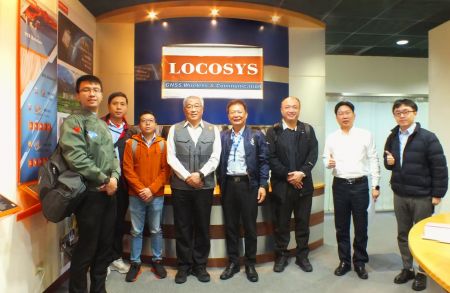 Taiwan Excellence Drone Alliance Visits LOCOSYS Technology, Focusing On Global Positioning Technology And Drone Applications
The Taiwan Excellence Drone Overseas Business Alliance, led by Yen Tung-Piao,visited a leading smart manufacturing enterprise with a delegation includingrepresentatives from AIDC, the Industrial...
Read More -
 LOCOSYS Showcases Advanced Smart Positioning Technology At New Taipei Electric Vehicle Supply Chain Expo
To promote the development of Taiwan's electric vehicle (EV) industry and enhance international collaboration, the New Taipei City Government hosted the Electric Vehicle Supply Chain Expo...
Read More