
01.04 LOCOSYS Targets High-Precision Positioning Market
2026/04/01 LOCOSYS
LOCOSYS Targets High-Precision Positioning Market
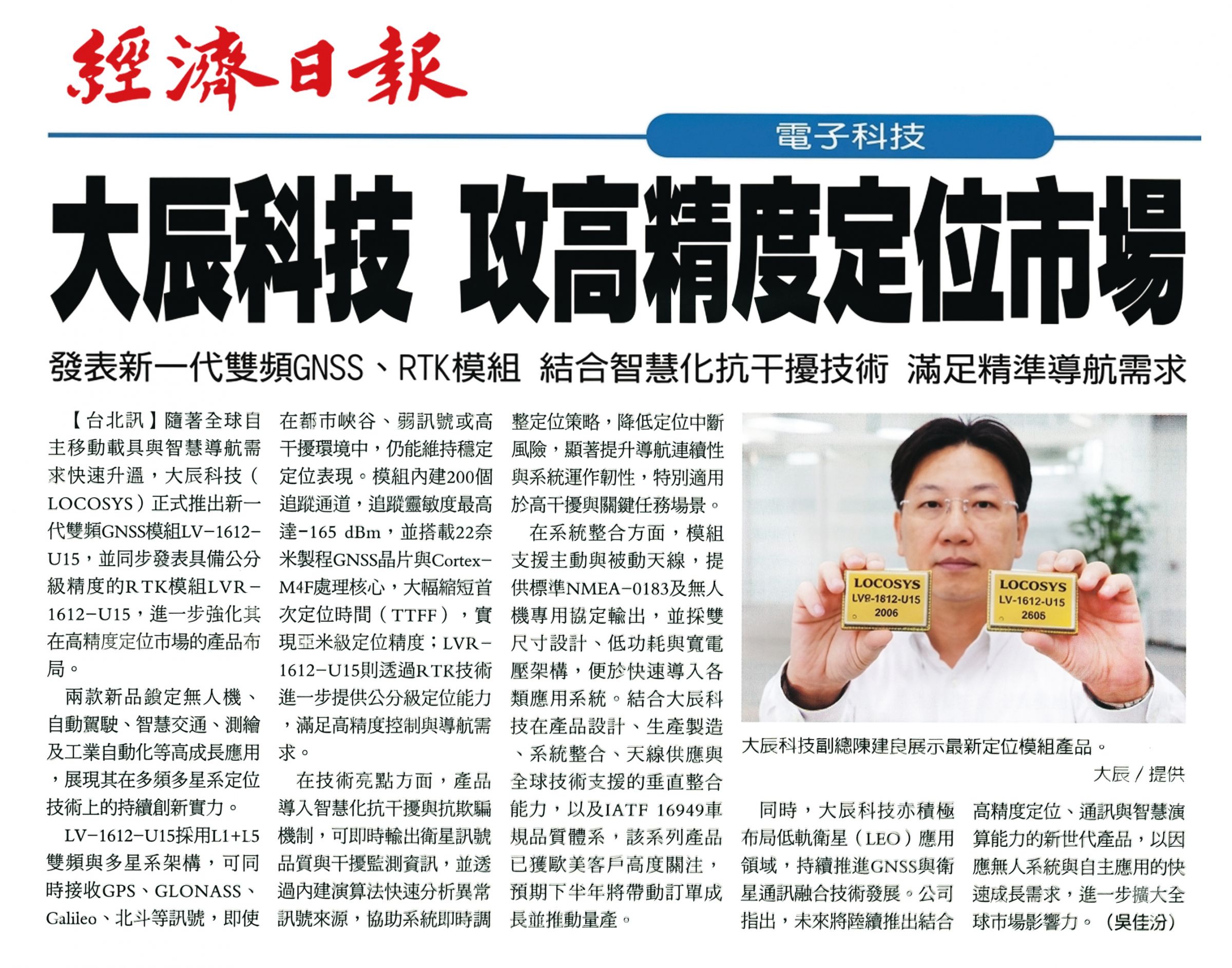
Launches New Dual-Frequency GNSS and RTK Modules with Intelligent Anti-Interference Technology to Meet Precision Navigation Demands
As global demand for autonomous mobile platforms and intelligent navigation continues to surge, LOCOSYS Technology has officially launched its new-generation dual-frequency GNSS module, the LV-1612-U15, along with the LVR-1612-U15 RTK module, which delivers centimeter-level accuracy. This move further strengthens the company’s product portfolio in the high-precision positioning market.
The two new products are designed for high-growth applications such as unmanned aerial vehicles (UAVs), autonomous driving, intelligent transportation, surveying, and industrial automation, demonstrating LOCOSYS’s continued innovation in multi-frequency, multi-constellation positioning technologies.
The LV-1612-U15 adopts an L1+L5 dual-frequency and multi-constellation architecture, enabling simultaneous reception of signals from GPS, GLONASS, Galileo, and BeiDou. Even in challenging environments such as urban canyons, weak signal conditions, or high-interference scenarios, it maintains stable positioning performance. The module features 200 tracking channels with sensitivity up to -165 dBm and integrates a 22 nm GNSS chipset with a Cortex-M4F processor core. This significantly reduces time to first fix (TTFF) and achieves sub-meter positioning accuracy. Meanwhile, the LVR-1612-U15 leverages RTK technology to deliver centimeter-level positioning accuracy, meeting the demands of high-precision control and navigation.
Complementing the LV-1612-U15, the LVR-1612-U15 RTK module provides centimeter-level positioning accuracy, making it well suited for high-precision applications such as autonomous driving, surveying, precision agriculture, and advanced UAV operations.
From a technical standpoint, the products incorporate intelligent anti-interference and anti-spoofing mechanisms. They can output real-time satellite signal quality and interference monitoring data, and utilize advanced algorithms to rapidly analyze abnormal signal sources. This enables systems to dynamically adjust positioning strategies, reducing the risk of positioning interruptions and significantly improving navigation continuity and system reliability—particularly in high-interference and mission-critical scenarios.
In terms of system integration, the modules support both active and passive antennas, provide standard NMEA-0183 and UAV-specific protocol outputs, and feature dual form factors, low power consumption, and a wide operating voltage range for easy integration into various applications. Backed by LOCOSYS’s vertically integrated capabilities in product design, manufacturing, system integration, antenna supply, and global technical support—as well as its IATF 16949 automotive-grade quality system—the product series has already attracted strong interest from European and American customers. Mass production and order growth are expected in the second half of the year.
A key highlight of the LV-1612-U15 is its advanced anti-jamming and anti-spoofing capabilities, combined with intelligent signal analytics. The module can output real-time satellite signal quality indicators and interference monitoring data, enhanced by AI-like algorithms for signal analysis and anomaly detection. This enables systems to proactively identify abnormal signal sources and respond dynamically. Through intelligent signal feature recognition and adaptive mitigation strategies, the module maintains positioning continuity even in complex or hostile RF environments, significantly reducing the risk of positioning failure and enhancing operational resilience and mission success rates in critical applications.
At the same time, LOCOSYS is actively expanding into low Earth orbit (LEO) satellite applications, advancing the integration of GNSS and satellite communication technologies. The company noted that it will continue to introduce next-generation products combining high-precision positioning, communications, and intelligent computing capabilities to meet the rapidly growing demand in unmanned systems and autonomous applications, further expanding its global market presence.
Press Release
-
 LOCOSYS Targets High-Precision Positioning Market
As global demand for autonomous mobile platforms and intelligent navigation continues to surge, LOCOSYS Technology has officially launched its new-generation dual-frequency GNSS module,...
Read More -
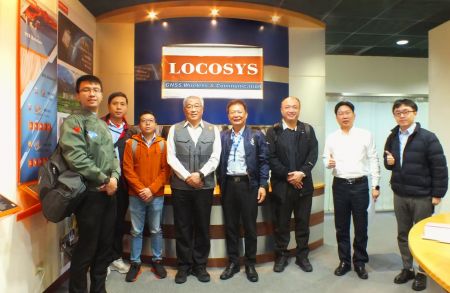 Taiwan Excellence Drone Alliance Visits LOCOSYS Technology, Focusing On Global Positioning Technology And Drone Applications
The Taiwan Excellence Drone Overseas Business Alliance, led by Yen Tung-Piao,visited a leading smart manufacturing enterprise with a delegation includingrepresentatives from AIDC, the Industrial...
Read More -
 LOCOSYS Showcases Advanced Smart Positioning Technology At New Taipei Electric Vehicle Supply Chain Expo
To promote the development of Taiwan's electric vehicle (EV) industry and enhance international collaboration, the New Taipei City Government hosted the Electric Vehicle Supply Chain Expo...
Read More