
-
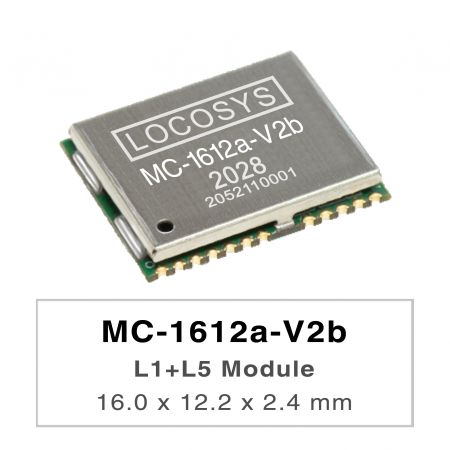
MC-1612a-V2b
MC-1612a-V2b
LOCOSYS MC-1612a-Vxx is a high-performance dual-band GNSS positioning module that is capable of tracking all global civil navigation systems. It adopts 12 nm process and integrates efficient power management architecture to perform low power and high sensitivity. Besides, concurrent reception of L1 and L5 band signals mitigates the multipath delay and achieves more accurate position. The module supports hybrid ephemeris prediction to achieve faster cold start. One is self-generated ephemeris prediction (called EPOC) that is no need of both network assistance and host CPU’s intervention. This is valid for up to 3 days and updates automatically from time to time when GNSS module is powered on and satellites are available. The other is server-generated ephemeris prediction (called EPO) that gets from an internet server. This is valid for up to 14 days. Both ephemeris predictions are stored in the on-board flash memory and perform a faster cold start. The RF front end of MC-161a-V3b the module is specifically designed to comply with sensitivity specification contained in AIS 140 standard. It is the best solution to those customers that design tracking applications in compliance with AIS 140.
-

MC-1612-V2b
MC-1612-V2b
LOCOSYS MC-1612-Vxx series are high-performance dual-band GNSS positioning modules that are capable of tracking all global civil navigation systems. They adopt 12 nm process and integrate efficient power management architecture to perform low power and high sensitivity. Besides, concurrent reception of L1 and L5 band signals mitigates the multipath delay and achieves sub-meter position accuracy. The modules support hybrid ephemeris prediction to achieve faster cold start. One is self-generated ephemeris prediction (called EPOC) that is no need of both network assistance and host CPU’s intervention. This is valid for up to 3 days and updates automatically from time to time when GNSS module is powered on and satellites are available. The other is server-generated ephemeris prediction (called EPO) that gets from an internet server. This is valid for up to 14 days. Both ephemeris predictions are stored in the on-board flash memory and perform a cold start time less than 15 seconds The RF front end of MC-1612-V3b the module is specifically designed to comply with sensitivity specification contained in AIS 140 standard. It is the best solution to those customers that design tracking applications in compliance with AIS 140.
-
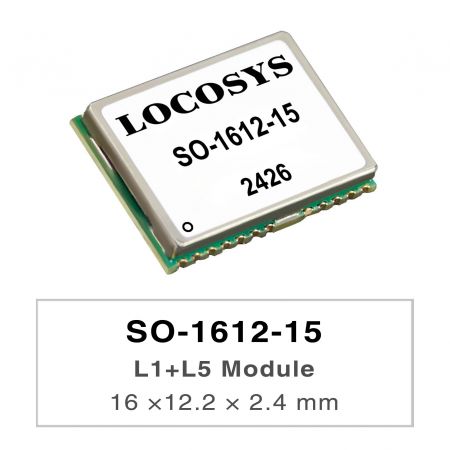
SO-1612-15
SO-1612-15
SO-1612-15 is a dual-band GNSS positioning receiving modules that a capable of tracking all global civil navigation systems (BDS, GPS, GLONASS, Galileo, QZSS, IRNSS and SBAS) in all band bands. Built-in highly integrated GNSS receiving chip supports the third generation Beidou Satellite Navigation System (BDS-3). SO-1612-15 module is based on the state of art BDS-3 architecture, integrating multi-band and multi-system GNSS RF and baseband. This newly designed architecture makes this single chip achieve sub-meter level position accuracy without correction data from ground-based augmentation station and higher sensitivity, greater for improved jam resistance and multipath, provide a highly robust service in complicated environment. SO-1612-15 module contains CXD5610GF positioning engine inside, featuring high sensitivity, low power consumption, and fast TTFF. The superior cold start sensitivity allows it to acquire, track, and get position fix autonomously in difficult weak signal environment. The receiver’s superior tracking sensitivity allows continuous position coverage in nearly all outdoor application environments.
-
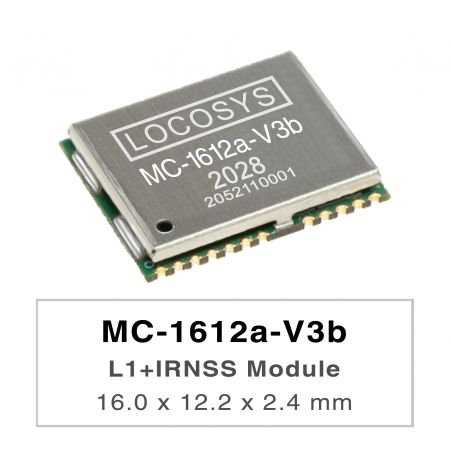
MC-1612a-V3b
MC-1612a-V3b
LOCOSYS MC-1612a-Vxx is a high-performance dual-band GNSS positioning module that is capable of tracking all global civil navigation systems. It adopts 12 nm process and integrates efficient power management architecture to perform low power and high sensitivity. Besides, concurrent reception of L1 and L5 band signals mitigates the multipath delay and achieves more accurate position. The module supports hybrid ephemeris prediction to achieve faster cold start. One is self-generated ephemeris prediction (called EPOC) that is no need of both network assistance and host CPU’s intervention. This is valid for up to 3 days and updates automatically from time to time when GNSS module is powered on and satellites are available. The other is server-generated ephemeris prediction (called EPO) that gets from an internet server. This is valid for up to 14 days. Both ephemeris predictions are stored in the on-board flash memory and perform a faster cold start. The RF front end of MC-161a-V3b the module is specifically designed to comply with sensitivity specification contained in AIS 140 standard. It is the best solution to those customers that design tracking applications in compliance with AIS 140.
-
-
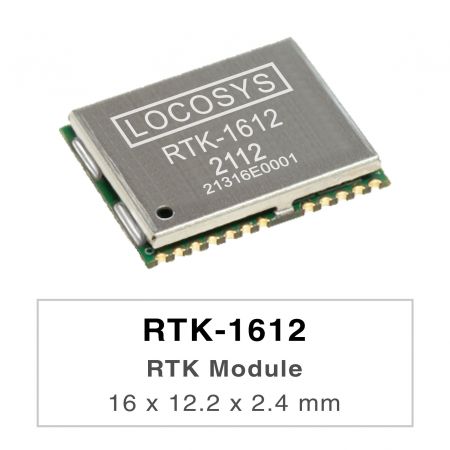
RTK-1612
RTK-1612
The RTK-1612 is a high-performance dual-band GNSS RTK module that designed for applications requiring centimeter level positioning accuracy. It adopts 12 nm process and integrate efficient power management architecture to perform low power and high sensitivity. The module supports concurrent reception of GPS, GLONASS, BeiDou, GALILEO, and QZSS to improve the availability and reliability of RTK solution even in the harsh environment.
بيان صحفي
-
 LOCOSYS تستهدف سوق تحديد المواقع عالية الدقة
مع استمرار الطلب العالمي على المنصات المتنقلة المستقلة والملاحة الذكية في الازدياد، أطلقت LOCOSYS Technology...
اقرأ أكثر -
 تحالف طائرات الدرون التايواني الممتاز يزور LOCOSYS Technology، مع التركيز على تكنولوجيا تحديد المواقع العالمية وتطبيقات الطائرات الدرون.
تحالف الأعمال الخارجية لطائرات الدرون المتميزة في تايوان، بقيادة يان تونغ-بياو، زار مؤسسة رائدة في التصنيع...
اقرأ أكثر -
 LOCOSYS تعرض تقنية تحديد المواقع الذكية المتقدمة في معرض سلسلة إمداد المركبات الكهربائية في تايبيه الجديدة
لتعزيز تطوير صناعة السيارات الكهربائية (EV) في تايوان وتعزيز التعاون الدولي، استضافت حكومة مدينة نيو تايبيه...
اقرأ أكثر